
Tin, tantalum, and tungsten rarely headline Africa’s minerals story. Yet 3T offers one of the clearest views into how value chains actually form, where risk can be structured, systems can hold, and business can quietly work.
Africa’s value-chain challenge is often framed as a question of ambition or industrial capacity. For investors and operators, the question is more practical: where can risk be bounded, throughput stabilised, and exits defined under current conditions?
3T is easy to overlook. It lacks the scale, price momentum, and narrative appeal of lithium or copper. But it operates under stricter buyer standards, clearer compliance regimes, and more established pathways into formal markets than many of the “strategic” minerals now attracting attention.
In Rwanda, disciplined cooperative structures, centralised washing and grading, enforced traceability, and controlled export channels enabled reliable supply before scale. This did not remove risk, nor is it easily replicable, but it showed that operational discipline can precede volume.
In parts of eastern DRC, outcomes diverged by durability. Where tagging, approved buying centres, and monitored export routes held, material flowed into compliant markets. Where enforcement weakened, value leaked quickly. The difference was not intent, but continuous execution.
Nigeria’s tin and columbite belts show potential without proof of scale. Small pilots combining shared processing and licensed buying points improved recovery locally, but struggled to persist without sustained institutional support.
The lesson is not that Africa’s value-chain problem is solved. It is that, in specific minerals and at specific choke points, risk can sometimes be structured rather than eliminated.
The tension is that 3T works precisely because it is narrow, constrained, and operationally unglamorous. Those same qualities often erode once scale or political ambition enter the picture. Where systems do hold, even briefly, they tend to strengthen logistics discipline, compliance norms, and institutional confidence; incremental reliability pulling wider systems forward.
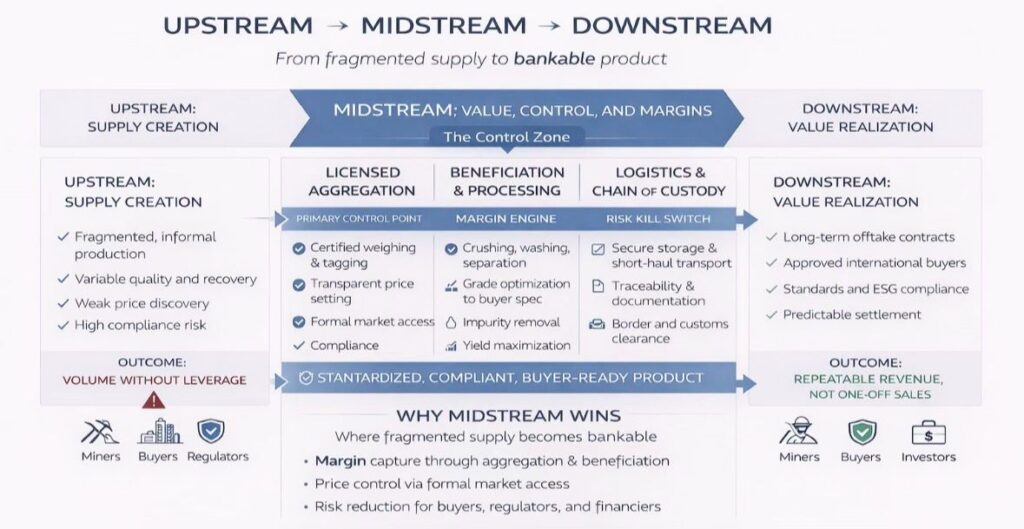
For 3T, the most credible entry points have been midstream:
• aggregation and licensed buying centres
• washing, grading, and concentration
• traceability and compliance systems
• logistics and export handling aligned to named buyers
These are not mining dreams. They are infrastructure and logistics businesses: capital-light relative to upstream mining, faster to stand up, and easier to exit. This is a narrow opportunity, not a platform strategy — but it is real.
Value chains don’t activate through announcements. They activate through enforced standards, boring infrastructure, and operators willing to work inside imperfect systems.