
One of the recurring themes across Africa’s industrialisation debate is infrastructure. But infrastructure itself only compounds when the underlying energy system behaves reliably.
This is where many value-chain discussions become detached from operational reality.
Mining, processing, industrial parks, cold chains, logistics corridors, ports, urban manufacturing, and even digital infrastructure all depend on one thing: sustained and predictable energy throughput.
Not announcements, not installed capacity, reliability.
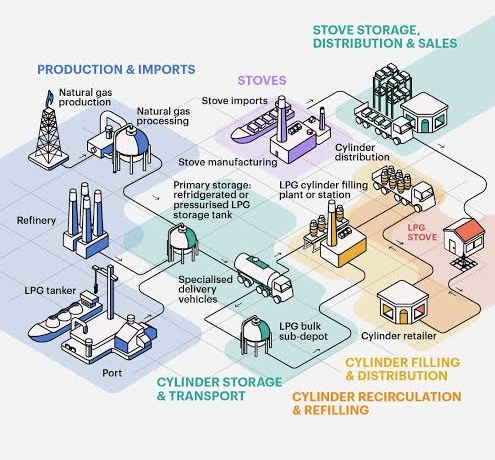
The World Liquid Gas Association’s recent LPG Roadmap for Africa is interesting for this reason. Beyond household energy access, it implicitly frames LPG as enabling infrastructure: stabilising urban energy demand, supporting industrial activity, reducing pressure on weak grids, and improving system resilience.
That matters because industrialisation rarely fails because demand is absent. It fails because systems cannot sustain reliable throughput long enough for capital, logistics, and operations to compound.
This challenge cuts across sectors.
Mineral processing becomes uneconomic when power volatility damages throughput consistency. Industrial zones struggle when backup generation becomes a permanent operating model. Transport and logistics corridors underperform when fuel systems remain fragmented and unreliable.
The real divide is increasingly not between resource-rich and resource-poor economies, but between systems that can sustain reliability and those that cannot.
This is also why energy discussions in Africa need to move beyond installed megawatts or transition slogans. The operational question is more practical:
Can power, fuel, transport, and logistics systems behave consistently enough to support industrial activity at scale?
Where they can, value chains deepen.
Where they cannot, projects remain isolated islands of activity surrounded by structural friction.
That is why energy systems matter far beyond energy itself.
Reliable energy is not simply an infrastructure category. It is the underlying condition that determines whether infrastructure, mining, manufacturing, and regional integration become cumulative or remain perpetually incomplete.